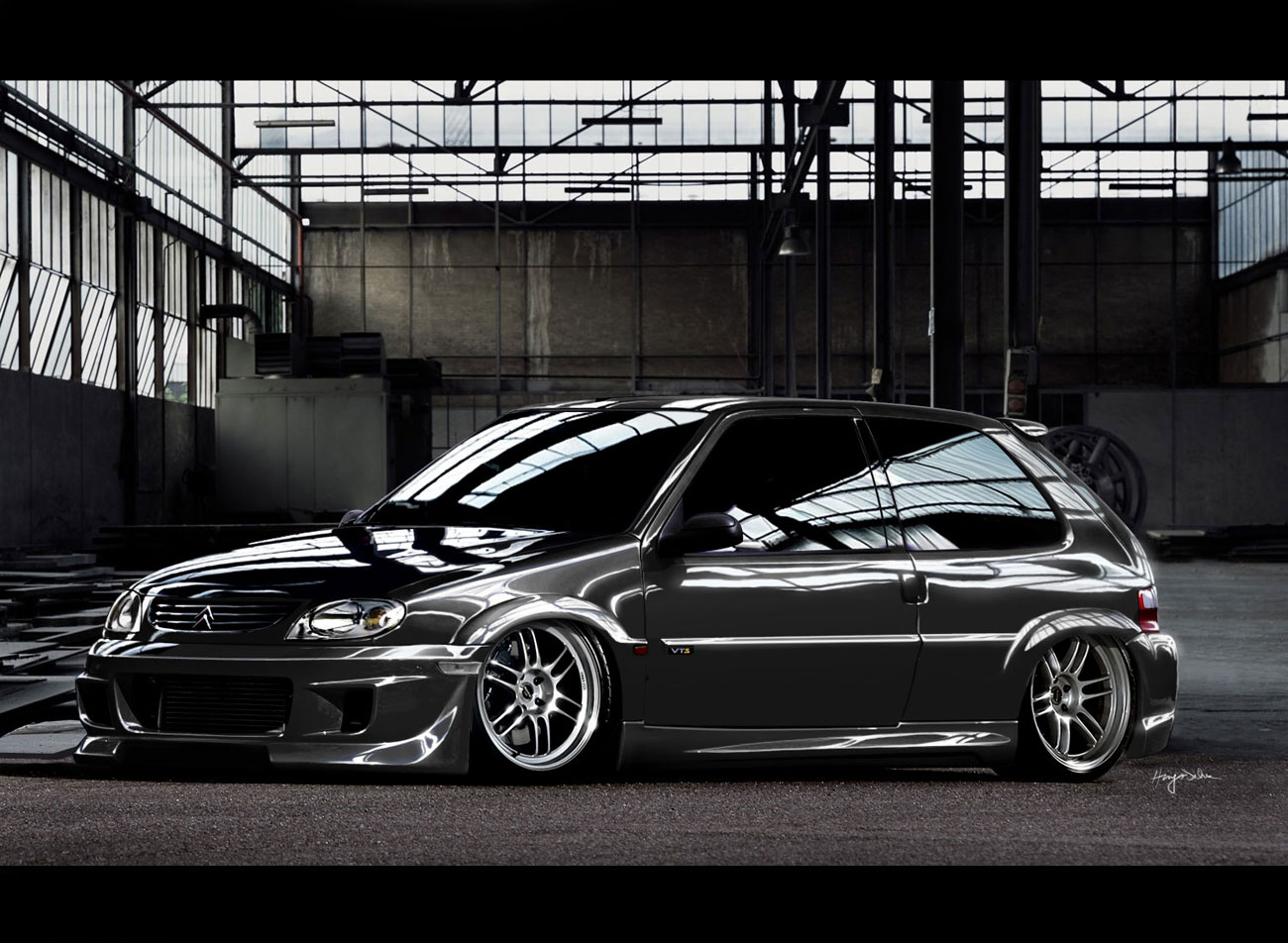
Citroen Saxo

The Citroen Saxo is a supermini produced by the French manufacturer Citroën (PSA) from 1996 to 2003. It was also sold in Japan as the Citroën Chanson. It shares many engine and body parts with the Peugeot 106 (which itself was a development of the Citroën AX), the major difference being interiors and body panels. It was replaced by the Citroën C2 in the autumn of 2003. All engines were from the PSA TU engine series that powered the Peugeot 205 from 1988 and the Citroën AX, and had their roots before that with the OHC PSA X engine various other PSA cars used, such as the Citroën Visa, Peugeot 104 and early Peugeot 205. The range included five petrol engines and one diesel engine, all naturally aspirated.

Although the power outputs seem low in modern terms, even the range-topping VTS had a kerb weight of just 965 kg (2,127 lb), giving all models quite a 'nippy' feel around town. The 1.0 was quite underpowered, the 1.1 was much better, since it was nearly 200 cc larger, and had roughly 30% more torque.There were 3 sport models of the Saxo:
* The Westcoast, later replaced by the Furio which featured a 1.4I 8V 55 kW (75PS/75BHP) engine with a top speed of 175 km/h (109 mph), and a 0-62.5 mph (0–100 km/h) time of 11.2 seconds.
* The VTR MK1 (1997–1999) featured a 1.6I 8V 66 kW (90PS/89BHP) engine with a top speed of 187 km/h (116 mph) and a 0-62.5 mph (0–100 km/h) time of 10.0 seconds. The VTR MK2 (1999–2003) featured a 1.6I 8V 72 kW (98PS/97BHP) engine with a top speed of 193 km/h (120 mph) and a 0-62.5 mph (0–100 km/h) time of 9.4 seconds.
* The VTS 16V featured a 1.6I 88 kW (120PS/118BHP) engine with a top speed of 205 km/h (127 mph), and a 0-60 mph time of 7.8 seconds. The VTS MK1 (1997–1999) and MK2 (1999–2003) shared the same performance.

These models included 247 mm (9.7 in) vented front brake discs, with the VTR and VTS also having rear brake discs (solid 247 mm (9.7 in) discs). Also, a different style of control arms and struts was used for the suspension. The VTS had a 22 mm (0.9 in) master brake cylinder, and the VTR and Westcoast/Furio had a 19 mm (0.7 in). The VTS had a 19 mm (0.7 in) front anti-roll bar and 22 mm (0.9 in) rear anti-roll bar, while the VTR and Westcoast/Furio had a 19 mm (0.7 in) front and 21 mm (0.8 in) or sometimes 19 mm (0.7 in) rear anti-roll bar.

In addition, all the sports models featured a different bodykit to the other models, commonly known as the "VT" bodykit. In 1997 the Saxo's 3 Speed Automatic Gearbox was combined with the 1.6i 8V 88 kW (90PS/89BHP) engine which was available on the Saxo SX and VSX. Then, in late 1997, the 1.6i automatic was replaced with a 1.4i 55 kW (75PS/74BHP) engine. The 1.6i was more powerful with a top speed of 176 km/h (109MPH) compared with the 1.4's top speed of 103 mph (166 km/h). Citroën carried on using the 1.4i engine on the Facelift Saxo Automatic in 1999. Due to the C3 having a 1.4i Automatic Gear Box the Saxo Automatic came to an end in March 2002, whilst the manual models were still sold right up to the end of 2003.

The equipment list was generally sparse, with budget models having drivers air bag, seat belt pre-tensioners, cassette player, heated rear screen and tinted windows, and early mk1's with keypad immobilisers and a clock in place of a tachometer and 3 stud wheels, much like the AX. Further up the list sunroofs, PAS, Electric windows, ultrasonic alarm, passenger airbag, CD player, tachometer, front fog lights, bodykits, colour coded mirror caps and alloy wheels were added, to name a few. The 1.6L VTR and VTS Saxo's were the best equipped, with both gaining rear disc brakes as opposed to drum brakes, and ABS as an optional extra on the VTR and standard on the VTS.
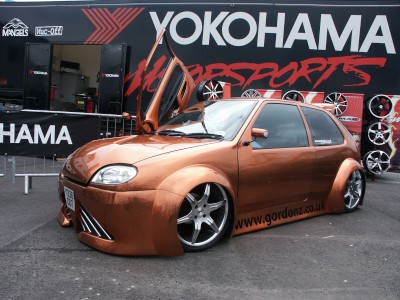
The Saxo received a style makeover at the start of the year 2000, commonly branded as a MK2, with the major differences being more modern styled headlights, bonnets and grilles to replace the square style on the MK1 and Multipoint injection replacing the single point on the 1.1L engines. PAS became standard on all but the very basic models. More subtle changes were alterations to the rear lights (the indicator sections are more "white") and the engine control unit moved from a single plug to 3 plugs. The old 3 stud wheel layout was also dropped. There was also a minor facelift during the MK1 phase of the cars production in line with the then current releases by Citroen, moving towards a rounder look.

Few special models were released throughout the Saxo's life, most notably the "Open Scandal", a Saxo with a full length sliding canvas roof. Other special editions added certain extra's to the lower end model, such as sunroofs or PAS. Notable models are the Westcoast up to 1999 and the Furio to 2003, as they incorporated the standard Saxo bodykit found on the VTR and VTS with a more insurance friendly 1.4L engine. Air-conditioning was never an option on right-hand-drive Saxo's because the blower motor was mounted in the bulk-head on the drivers side. As a result, there was insufficient space available to accommodate the evaporator, except by first ducting the air flow to the passenger side and then at the expense of the glove-box. Although an after-market kit was available that did exactly this, the resultant pressure loss made the system noisy and ineffective. The blower motor could also not be easily relocated, since the windscreen wiper motor was mounted in the passenger side space.

The Citroen Saxo (as well as the Peugeot 106) was and still is a favourite for young drivers who have just passed their test as a first car due to low insurance (except vts version), low running costs and they are very cheap to buy. When new, the Saxo came with low finance and free insurance deals for young drivers which helped to boost its appeal to younger drivers. The Saxo is a car modifiers favourite due to this appeal with several body styling and tuning options (more so for vtr and vts versions) available with some people spending thousands of pounds on their cars. Top Gear presenter Jeremy Clarkson once visited a cruise with the Saxo's replacement - the Citroen C2 - to find out if the C2 had the same modifying potential as the Saxo.
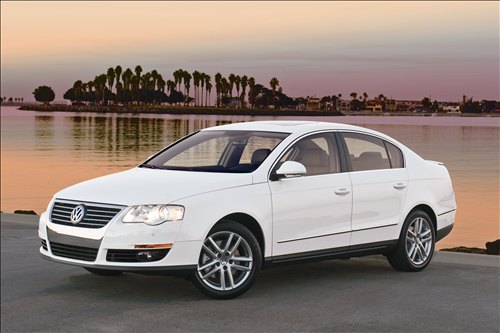
Volkswagen Passat

The Volkswagen Passat is a large family car built by Volkswagen Passenger Cars through six design generations since 1973. Slotting between the Volkswagen Golf / Volkswagen Jetta, and the Volkswagen Phaeton in the current Volkswagen line-up, the Passat and its derivatives have been badged variously as Dasher, Santana, Quantum, Magotan, Corsar and Carat. In 2008, Volkswagen extended its range with the launch of the Passat CC, a "4-door coupé" version of the Passat. The Passat was placed in the middle of the sedan/saloon market segment at its introduction in 1973. Sales of the aging Beetle were declining and larger air-cooled rear-engined models like the Volkswagen Type 3 and 411 and 412 were based on older technology.

Following the Volkswagen Group's acquisition of Audi in 1964, Volkswagen used new engineering expertise to develop a modern front-wheel drive car with a water-cooled engine, and thus the Passat and Golf (the latter being introduced in 1974) were the first of a new generation of Volkswagen cars. The first Passat was developed partly from the Audi 80/Fox and, until 2005, the two shared a history. During its development phase, the Passat was designated internally as EA400 (Entwicklungsauftrag 400, or "Development Order 400"), and well before its launch, production of the Volkswagen Type 3 at the Wolfsburg plant had been stopped in order to free up capacity for the new car. Wolfsburg was able to ramp up production carefully: directly before Passat production started the lines were used to assemble small volumes of the car's Audi 80 sibling which had been launched a year earlier. The nameplate Passat derives from the German word for tradewind — and the period in its history when Volkswagen named vehicles after prominent winds, including also Golf (after the Gulf stream, Jetta (after Jet stream), and Scirocco (after Sirocco).

The original Volkswagen Passat was launched in 1973. The body types offered originally were 2- and 4-door sedans and similar looking three- and five-door versions. Externally all four shared a modern fastback style design, styled by the Italian designer Giorgetto Giugiaro. In essence, the first Passat was a fastback version of the mechanically identical Audi 80 sedan, introduced a year earlier. A five-door station wagon/estate was introduced in 1974. In Europe, the Passat was equipped with 2 rectangular, 2 round 7", or 4 round 5.5" headlights depending on specification. The Passat was one of the most modern European family cars at the time, and was intended as a replacement for the aging Volkswagen Type 3 and Type 4. The Passat was Wheels magazine's Car of the Year for 1974 and its sister model Audi 80 was nominated car of the year by the European motor press a year earlier. The platform was named B1.

The Passat originally used the 4 cylinder OHC 1.3 l (55 PS (40 kW; 54 hp)) and 1.5 l (75 PS (55 kW; 74 hp)/85 PS (63 kW; 84 hp)) petrol engines also used in the Audi 80—longitudinally mounted with front-wheel drive, in Audi tradition, with either a 4-speed manual transmission or 3-speed automatic. It had a MacPherson strut front suspension with a solid axle/coil spring setup at the rear. The SOHC 1.5 was enlarged to 1.6 l in August 1975 with unchanged power ratings and slightly higher torque ratings. In July 1978 the Passat Diesel became available, equipped with the VW Golf`s 1.5 l Diesel (50 PS (37 kW; 49 hp)), followed in February 1979 by the Passat GLI with a fuel-injected version of the 1.6 l engine. The whole range received a facelift in 1977 (launched 1978 outside Europe), featuring an interior upgrade and subtly revised styling including repositioned indicators and depending on model, either 4 round or 2 rectangular headlights.

In North America, the car was called the Volkswagen Dasher. The three- and five-door hatchback and a station wagon model were launched in North America for and during the 1974 model year. Sole available engine was a carburetted 1.5 l inline-four developing 75 hp (56 kW) (or 70 hp (52 kW) in 1975), supplanted from model year 1976 by a Bosch fuel-injected 1.6 l four 78 hp (58 kW). North American cars were equipped with single DOT standard headlights. In 1978 the Dasher received a facelift along the lines of the European Passat, with quad sealed beam headlights and big polyurethane covered bumpers. The trim was also upgraded and the ride softened. 1979 saw the introduction of the 1.5 l diesel engine, which produced just 48 PS (35 kW) in the 1130 kg (2500 lb) car. 0–100 km/h time for the Diesel was 19.4 seconds, 6.2 seconds slower than the gasoline (petrol) engine. All gasoline engines were dropped for North America in 1981 in preparation for the next generation.

The second generation Volkswagen Passat was launched in 1981. The platform, named B2, was slightly longer and the car's updated styling was instantly recognisable as a Passat, with the most obvious difference being the rectangular headlights. In addition to the Passat hatchbacks and Variants (estate/wagon), there was also a conventional three-box saloon, which until the 1985 facelift was sold as the Volkswagen Santana in Europe. In North America, the Passat/Santana was sold as the Volkswagen Quantum, available in three-door hatchback, four-door sedan, and a wagon model, but the five-door hatchback was never sold there and the three-door hatchback was dropped after less than two years. The four-wheel drive Syncro version was introduced in October 1984, initially only with the more powerful 5-cylinder engine. The Santana was also produced in China, Brazil, Mexico (as the Corsar, from 1984 and 1988) and Argentina (as the Carat between 1987 and 1991). In Brazil, the Santana station wagon was sold as the Quantum. The Passat saloon and estate were produced in South Africa for their local market until 1987. As of 2010[update] the B2 Santana is still in production in China.

Like the previous generation, the B2 Passat was mainly sold with 4-cylinder petrol and diesel engines. Unlike its predecessor, however, top-of the line versions received 5 cylinder Audi or VW engines of 1.9–2.2 litres. In addition to four- and five-speed manuals and three-speed automatic gearboxes, the Passat/Santana was also available with the VW concern's interesting 4+E transmission. This, also called the "Formel E" had a particularly high top gear, which combined with a freewheeling mechanism to provide better gas mileage. An automatic stop/start was also available in some markets. The four-wheel drive system used in the Passat Variant Syncro shared the mechanics of the Audi 80 quattro and not the Volkswagen Golf Syncro. The Syncro's bottomplate was almost entirely different, requiring a transmission tunnel, a relocated gas tank and no spare tire well (to make room for the complex rear axle assembly). Only the more popular estate was reengineered. Syncro was also available in the North American market, only with the 5 cylinder engine.

In 1985 the range received a slight facelift, consisting of new, larger bumpers, interior retouches, a new front grille and new taillights on the hatchback versions. The 2-door hatchback was discontinued while the Santana nameplate was dropped in Europe. The saloon's front end was now the same as the hatchback and estate. The North American version, still known as the Quantum, gained European-style composite headlamps. On March 31, 1988 production ended (although Syncro models continued in production until June) with 3,345,248 built in Germany. World production totals

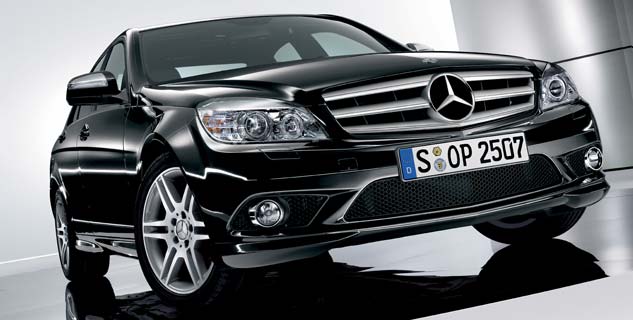
Mercedes-Benz C Class

The Mercedes-Benz C-Class is a compact executive car produced by the Mercedes-Benz division of Daimler AG. First introduced in 1993 as a replacement for the 190 range, the C-Class was nicknamed the "Baby Benz" as it was the smallest model in the marque's lineup until the 1997 arrival of the A-Class. The C-Class is built at Mercedes-Benz factories in Sindelfingen and Bremen, Germany, in Santiago Tianguistenco, Mexico by Mercedes-Benz-Xicotencatl as well as in Mercedes's factories in Brazil and DaimlerChrysler's South African factory in East London. The very first W202 C-Class sedan was produced on June 1, 1993, and the second generation W203 C-Class rolled off the assembly line on July 18, 2000. The third generation W204 C-Class was launched in 2007. The C-Class is the entry-level offering in Mercedes-Benz's United States lineup. The C-Class platform has been used for several coupes, including the CLC-Class (and its predecessor, the C-Class Sportcoupe) and the E-class Coupe (and its predecessor, the CLK-Class).

At the launch all W202 variants were equipped with a 5-speed manual gearbox. The 722.4 4-speed automatic transmission, also called 4G-TRONIC, was available as extra cost (standard on the C 36 AMG). In 1996 this old transmission - which was on sale since 1981 - was replaced by a 5-speed automatic gearbox (aka 722.5 or 5G-TRONIC), which received the manual shifting in 1999 (722.6). In 2000 the T-Modell, the only still on sale, was equipped with the G56 6-speed manual transmission. At the launch the C-Class had a standard driver airbag, ABS and integrated side-impact protection; the front passenger airbag became standard from 1995 onwards, and from the same period Traction control (ETS in the 4-cylinder models, combined with limited slip differential (ASD) or ASR in the 6 cylinders models) was available as extra cost. In 1997 ASR became standard in the C 280s equipped with the automatic transmission and in the C 36 AMG, as ETS in the 4-cylinder models, except for the C 180 and the C 220 Diesel. With the 1997 restyling ASR became standard in all the models, except in the C 180 and C 220 Diesel. This last model continued to offer ETS available as extra cost. Moreover front side airbags and Brake assist (BAS) came in the list of standard safety features. The two basic models finally joined ASR in 1998, and, in 1999, the W202 was the first mid-size sedan to offer ESP as standard in all the range.

On its debut, the C-Class was the only Mercedes model with a complete lineup of multi-valve engines. The new family of four cylinder petrol units, called M111, debuted in the C 180 (1.8 L, 122 PS (90 kW; 120 hp)), C 200 (2.0 L, 136 PS (100 kW; 134 hp) and C 220 (2.2 L, 150 PS (110 kW; 148 hp), the only four cylinder of the range sold in the U.S.). In 1996 the C 220 was replaced by the C 230, enlarged to 2.3 L displacement but with the same output, although with torque increased to 220 N·m (162 lb·ft). The C 280 was the high end model of the class, with a four-valve-per-cylinder straight-6 engine, capable of reaching 193 PS (142 kW; 190 hp). Four-cylinder diesel models were equipped with the same OM601 engine of the 190, in the 2.0 L and 2.2 L versions. Many of these diesel variants were sold as taxis, due to their low fuel consumption and strong reliability. There were also more powerful OM605 five cylinder engines which were available in naturally aspired (C 250 D) and turbocharged (C 250 TD) forms. The turbodiesel was introduced in 1995 and is one of the novelties in the engine range available from this year. The most important was a supercharged version of the M111 straight four, the C 230 Kompressor, using a Roots-type supercharger to generate 193 PS (142 kW; 190 hp) at 5300 rpm: Mercedes-Benz reused supercharger technology after 50 years. Due to the tax law in Italy and Portugal, models in those countries featured a supercharged version of the smaller 2.0 L (C 200 Kompressor), which had a similar output of the C 230 Kompressor. With the restyling in 1997, a lot of things changed under the hood of the Baby Benz. The most important innovation was the OM611, equipped with a common rail direct injection system (co-developed with Bosch). The new model was named C 220 CDI, and had an improvement in output of 30 PS (22 kW; 30 hp) compared with the C 220 Diesel, better fuel average and lower emissions. Another revolution occurred to the six cylinder engines, as the legendary straight six were replaced by an all new family of V6, the M112. The new engines featured SOHC heads instead of the previous DOHC, three valves per cylinder instead of four, and twin sparkplugs. The four-cylinder C 230 was replaced by the C 240 (2.4 L) and the I6 C 280 by the V6 C 280. These changes theoretically reduced emissions, and improved fuel consumption, without sacrificing power (the C 280 in (7,112 mm) fact had a slight 4 PS (3 kW; 4 hp) increase with the change). In the last four years of production, the W202 received a few changes in the choices of engine. In 1998, a less powerful version of the 2.2 L turbodiesel was added, called C 200 CDI, which replaced the C 220 Diesel. In 2000, the C 200 Kompressor T's output was cut to 163 PS (120 kW; 161 hp), the C 240 T displacement was enlarged from 2.4 L to 2.6 L, but output remained at 170 PS (130 kW; 170 hp) and the C 180 got a 2.0 L engine.

Ford Fiesta


Ford Fiesta Review Videos

Ford Fiesta Concept
Ford Fiesta New Design
Fast Ford Fiesta
Elegant Ford Fiesta
Cool Ford Fiesta
Ford Fiesta Hatchback
Orange Ford Fiesta
Sporty Ford Fiesta
Ford Fiesta Steering Wheels

Renault Clio

The Renault Clio is a supermini car produced by the French automobile manufacturer Renault. Originally launched in 1990, it is currently in its third generation. The Clio has seen substantial critical and commercial success, being consistently one of Europe's top-selling cars since its launch, and it is largely credited with restoring Renault's reputation and stature after a difficult second half of the 1980s. Symbol of its success and its longevity, the Clio is the only car to have been elected European Car of the Year twice, in 1991 and in 2006. The Clio has been sold as the Renault Lutecia in Japan, as Honda owns the right to the name Clio (being one of Honda's sales networks in Japan). A four-door saloon was developed for certain markets where sedans are traditionally preferred over hatchbacks and is sold under names Renault Clio Classic, Renault Clio Symbol, Renault Symbol, Renault Clio Sedan, Renault Clio Tricorps, and Renault Thalia. It is also sold under the Nissan nameplate in some Latin American markets as the Nissan Platina with slight changes in the front of the car to make it resemble the Nissan Altima.

The Clio was introduced at the Paris Motor Show in June 1990 and sales in France and the rest of the continent began then, although sales in Britain did not begin until March 1991. The Clio largely replaced the Renault 5 (which continued to be built in lower volumes until 1996 in Slovenia as a budget alternative). The engine range available at launch included 1.2 L and 1.4 L E-type "Energy" petrol I4 engines (first seen in the R19) and 1.7 L and a 1.9 L diesel (both based on the F-type unit) engines. The petrol engines all received an electronic fuel injection system in place of carburettors in 1992, in order to conform to new pollutant emission regulations. A minor trim facelift occurred after only a year of being on sale. A new "smooth" version of the Renault diamond badge (the previous "ribbed" badge was being phased out at the time) and a new front seat design were the only changes. The altered design did not constitute a new "phase". In March 1993, the Phase 2 model was launched, with small updates to the exterior and interior of the Clio. Most noticeable was the change in the front grille from two metal ribs to a single colour-coded slat grille. The bump strips were made slightly larger and rounder, and the car's trim level badge was incorporated into the bump strips. The badges on the tailgate strip were moved up onto the tailgate itself and the tailgate strip was given a carbon fibre look. The rear light clusters were given a slightly more rounded bubble shape to them, giving the Clio a more modern look. The clusters, however, are physically interchangeable with Phase 1 clusters.


Renault also released a warm hatch version of the Clio. It was aesthetically very similar, but with the addition of a 110 PS (81 kW) 1.8 L 8-valve engine, side skirts and disc brakes on all wheels. This was badged as the RSi. During 1991, a 1.8 L 16-valve engine producing 137 PS (101 kW) (also first seen in the R19) capable of propelling the car to 208 km/h (129 mph) was introduced to the Clio engine range, known simply as the Clio 16S in France (S for "soupapes", the French word for valves), and Clio 16V in export markets. As well as having higher top speed than a regular Clio, the 16S sported wider plastic front bumpers, an offset bonnet vent, wider rear bumpers and uprated suspension and brakes, and colour-coded front mirrors and bumpers. The RSi side skirts were omitted, however. Interior wise, the 16V model had an extended instrument panel that housed dials for engine oil pressure, oil temperature, and oil level (which only indicates on engine start). The seats were also more supportive to match the sporting nature of the model.

Gumpert Apollo


Gumpert Apollo

Black Gumpert Apollo
Amazing Gumpert Apollo
Sporty Gumpert Apollo
Cool Gumpert Apollo
Red Gumpert Apollo
Impressive Gumpert Apollo
Gumpert Apollo Interior

Toyota Avensis

The Toyota Avensis is a large family car built in Derbyshire, United Kingdom by Japanese carmaker Toyota since 1997. It is the direct successor to the Carina E and is available as a four-door saloon, five-door liftback and estate. A large MPV called the Toyota Avensis Verso (Toyota Ipsum in Japan and previously the Toyota Picnic in other markets) is built in Japan on a separate platform. The Avensis is the basis for the youth-oriented Scion tC, which is produced for the US market. The Toyota Avensis was introduced in 1997, to create a more modern name when compared with the reliable, but dull Toyota Carina E/Toyota Corona. Like its predecessor the Avensis was reliable, and proved a sales success for Toyota Europe. Over the years, the Toyota Avensis has advanced in size, technology, power, and economy to challenge its rivals, like the Mazda6, Ford Mondeo, Volkswagen Passat, Opel/Vauxhall Insignia, Citroën C5 and Peugeot 407.

The Avensis offers two petrol and two diesel engine options. The new engines feature more power and lower CO2 emissions. The new ZR engines became the first to introduce Toyota's Valvematic technology.
* 1.6-litre 1ZR-FAE 132 hp (98 kW)
* 1.8-litre 2ZR-FAE 147 hp (110 kW)
* 2.0-litre 3ZR-FAE 152 hp (113 kW)
* 2.2-litre 150 hp (112 kW)
* 2.2-litre 177 hp (132 kW)
All gasoline engines are mated to a 6-speed manual transmission while the 1.8 L and 2.0 L offer a Multidrive S CVT transmission.

Black Toyota Avensis
Sporty Toyota Avensis
Toyota Avensis Engine Detail
Silver Toyota Avensis


Toyota Avensis
Related Posts Plugin for WordPress, Blogger...