Mazda RX-8 Top Gear

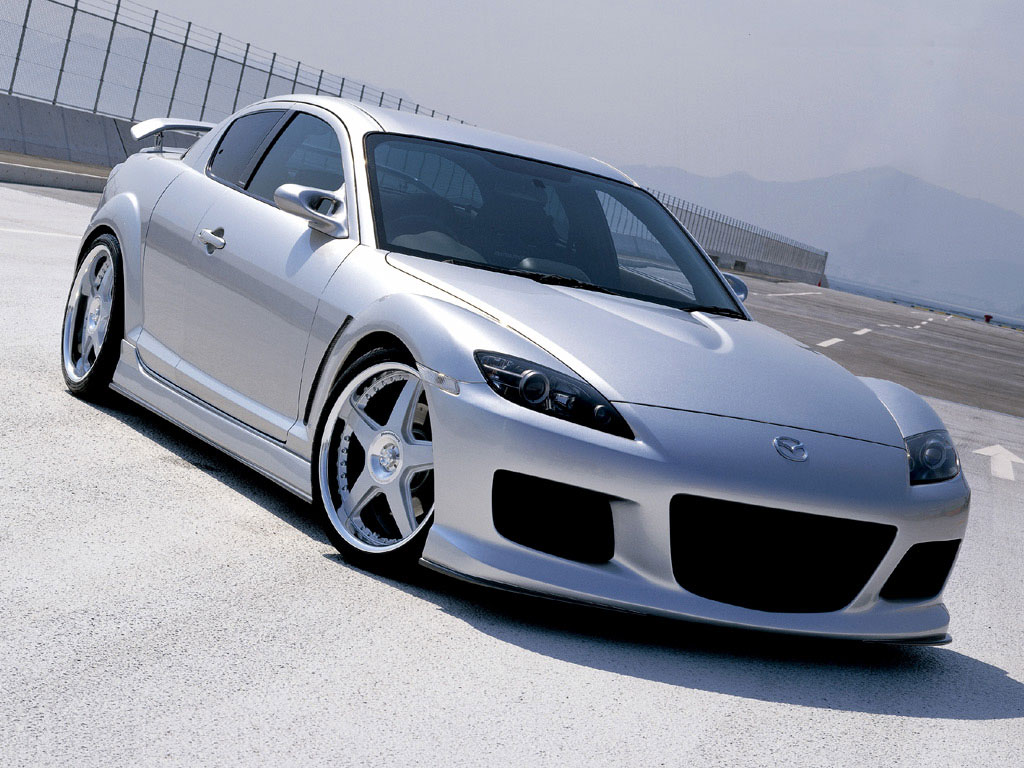
The Mazda RX-8 is a sports car manufactured by Mazda Motor Corporation. It first appeared in 2001 at the North American International Auto Show. It is the successor to the RX-7 and, like its predecessors in the RX range, it is powered by a rotary engine. The RX-8 began North American sales in the 2004 model year.Mazda introduced rotary engine vehicles in the US in 1971, beginning with the R100, followed by RX-2, RX-3, RX-4, RX-5, and finally three generations of the RX-7 sports car. However, the lack of creature comfort and user-friendliness, coupled with the high price tag and declining interest in sports cars and coupes at this time, led Mazda to pull the RX-7 from most major markets except Japan. After 1995, Mazda suffered from a relatively undistinguished product line in the US save the MX-5 Miata. As popular interest in import tuning and performance cars resurged in the late-1990s, thanks in part to various popular cultural influences such as the Sony PlayStation video game Gran Turismo, Japanese automakers waded back into the performance and sports car market in the US. In addition, Mazda endeavored to rejuvenate itself around this time, partially with financial and management assistance from Ford, and successfully developed a new product line of high quality cars with desirable styling and superior driving dynamics, beginning with the Mazda6 and followed by the Mazda3, paving way for the arrival for Mazda's next-generation rotary sports car.

Blue Mazda RX-8

Mazda RX-8 Speedometer

Development of the RX-8 can be traced to as far back as the 1995 Mazda RX-01 concept car, which featured an early iteration of the 13B-MSP engine. Naturally aspirated with side exhaust ports, this engine produced 220 hp (160 kW). As prohibited by Mazda's financial state at the time and the growing market interest in SUVs, the RX-01 never saw further development or production. However, a "skunkworks project" engineering team within Mazda kept the development of the 13B-MSP alive using MX-5 Miata chassis, eventually catching the attention of management, which at this time had come under heavy influence from Ford. Development of the 13B-MSP advanced and eventually led to the RENESIS moniker debuting along with the RX-EVOLV concept car which began to bear semblance to the production RX-8 with the "freestyle" rear suicide doors. Styling was developed via design competitions in Mazda tradition among its design studios in Japan, the US, and Europe. The project obtained official approval from management, and eventually the RX-8 concept car (design/engineering model) was produced and shown in 2001, closer resembling the production version. A near-production "reference exhibit" RX-8 was shown shortly thereafter at the 2001 Tokyo Motor Show, pending final approval for production. Production RX-8 closely resembles this vehicle save for minor trim details, and "job 1" began in February 2003 at Mazda's Hiroshima plant in Japan. The RX-8 was designed as a front mid-engine, rear-wheel drive four-seat four-door coupé. The car has 52:48 front-rear weight distribution, and a low Polar Moment that is achieved by mounting the engine behind the front axle and the fuel tank ahead of the rear axle. The front wheels feature classic independent double wishbone suspension, while the rear are independent multi-link. Weight is trimmed through the use of materials such as aluminium and plastic for several body panels. The rest of the body is steel, save for the plastic front and rear bumpers. The manual gearbox model uses a carbon fiber composite driveshaft to reduce the rotational mass (moment of inertia) connected to the engine. Power is sent to the rear wheels via a Torsen limited slip differential for improved handling. While its not quite in the league as the last RX-7 in terms of raw performance, the RX-8 is considered its successor as Mazda's rotary engine sports car. Its layout and clever engineering, along with typical Mazda suspension tuning, have endowed it with excellent driving dynamics which have garnered much praise and numerous awards. It has also proven popular in Japan among car enthusiasts as well as aftermarket equipment manufacturers and professional tuners. A prominent feature of the RX-8 is a pair of rear-hinged "freestyle" doors (similar to suicide doors) in order to provide easier access to the rear seats. The RX-8 has no B-pillar between the front and rear doors, with the leading edge of the rear door acting as a "virtual pillar" to maintain structural rigidity. Because of the overlapping design, the rear doors can be opened only when the front doors are open. Although by no means expansive, the RX-8's cabin was designed to allow enough room to house four adults, making it a genuine 4-seater rather than a 2+2. The first version of the RX-8, chassis code SE3P, was produced from model year 2003. It is powered by the RENESIS 13B-MSP (multi side port) Wankel rotary engine displacing 1.3 litres (2x654 cc). At launch, the RENESIS was available in standard and high power versions. The 4-port standard RENESIS produced 210 hp (160 kW) and was coupled with either a 5-speed manual or 4-speed automatic transmission. The 6-port high power RENESIS was only available with a six-speed manual transmission and was rated at 250 hp (190 kW). For the North American market, Mazda revised the reported output rating of the standard and high power RENESIS soon after launch to 197 hp (147 kW) and 238 hp (177 kW), respectively.[2] With exhaust ports now located in the side housing, the RENESIS boasted improved fuel efficiency and emissions rating over the 13B-REW employed by the last RX-7, thereby making it possible to be sold in North America. At launch, the RX-8 was available in various models in different markets around the world.
Standard models include:
* 6-speed manual "High Power" with a claimed output of 184 kW (250 PS; 247 hp) and a 9,000 rpm redline (Sold in NZ). This model was equivalent to the "Type S" trim in Japan.
* 5-speed manual "Standard Power" tuned to 141 kW (192 PS; 189 hp) with the redline reduced to 7,500 rpm. This powertrain combination was not available in North America.
* 4-speed automatic tuned to 141 kW (192 PS; 189 hp) in some markets (NZ), while the U.S. automatic is stated to deliver 158 kW (215 PS; 212 hp) .
* 6-speed automatic (available in the U.S. market after 2006) developing 158 kW (215 PS; 212 hp) and 159 lb·ft (216 N·m) of torque with a redline at 7,500 rpm.[3] This was the revised standard RENESIS, now with two extra intake ports like the high power version.
Automatic versions all had low output/low rpm engines due to the lack of availability of a transmission that would reliably turn 9,500rpm.

Mazda RX-8 Interior

Mazda RX-8 Engine Detail

For 2009, mazda engineers improved the RX-8 body rigidity through the addition of structural reinforcements, by adding a trapezoidal strut tower bar and enhancing the local rigidity of the front suspension tower areas. The 2009 RX-8 is also 90 lbs lighter than the previous (2003-2008) models. Also, the rear suspension geometry has been reconfigured for better handling by improving drivshaft rigidity, lowering NVH levels, and improving overall performance. The 09 RX-8 has a different gearing ratio (on manual transmission-equipped cars) that is lowered from 4.444 to 4.777 for improved off-the-line performance. While minimal, these performance changes give the 2009 RX-8 increased acceleration and performance, as well as even greater responsiveness to the accelerator pedal. Mazda claims that the 09 RX-8 is a significantly faster car than the previous (2003–2008) model car due to the lighter weight, lowered gearing, and improved suspension. The 2009 RX-8 also receives design enhancements that are meant to freshen the styling and give the RX-8 a new look, without impairing the basic design theme. Refinements for the 2009 model year include a more aggressive restyled front and rear bumper as well as a new front fascia. The 09 RX-8 also comes with sporty, high-quality finish front and rear headlamps as well as larger exhaust pipes (now measuring 90 mm across). The 2009 RX-8 also offers a new five-spoke wheel design featuring a symbolic and sporty design reminiscent of the rotary engine, with different arrangements for each wheel size. There are currently three trims available to consumers: Sport, Grand Touring, and R3. Mazda North American Operations extended the engine warranty on RX-8s built between 2004 and 2008 to 8 years or 100,000 miles. The warranty extension covers the engine core which consists of the rotor housing and internal parts as well as the seals and gaskets. A copy of the extended warranty can be found at Racing Beat's websiteMazdaspeed, Mazda's in-house tuning and high-performance arm, has produced various after-sale parts and accessories for the RX-8, including full body kits, suspension upgrades, engine upgrades (such as cold air intake kit and catback exhausts), and various interior accessories. In addition, Mazdaspeed has also produced several series of showroom-ready limited-production RX-8s in Japan featuring some of these parts and accessories. To date, however, there has not yet been a full Mazdaspeed-tuned RX-8 along the same line as the Mazdaspeed6 or Mazdaspeed3. The RX-8 has been campaigned and used in various racing series by privateers. It has seen a considerable amount of success, the most prominent of which being the 2008 and 2010 24 Hours of Daytona GT-class wins campaigned by SpeedSource Race Engineering. This victory also marks the 23rd endurance race win at Daytona by Mazda rotary-powered race car. While the cars are powered by the 20B rotary engines, the car is in fact built on a tube frame chassis and not on the production car. Ryan Eversley won both races of the 2010 SCCA World Challenge Mid-Ohio Grand Prix in the touring car class. Other racing series include the KONI Challenge Series in the Street Tuner class. In the UK, the RX8 featured in the Mazda sponsored "Formula Women" series (2004), which involved all women drivers with slightly modified RX8s, and the RX8 was also run successfully in Britcar series endurance races (2005 / 2006) In Belgium, Mazda are currently sponsoring an RX8 silhouette racer in the GT series. The next generation rotary engine, dubbed "16X," is currently under development. Rumours also suggest that the RX-8 may be replaced by a new smaller, lighter, simpler rotary engine sports car similar in spirit to the original RX-7 and set to compete with the likes of the upcoming Toyota FT-86. Some sources would think the redesigned next generation model will replace it.As of October 2006 the RX-8 has won at least 37 international motoring awards including 2003 International Engine of the Year, the 2003 Japanese Car of the Year, Australia's Wheels magazine's Car of the Year for 2003, the 2004 Singapore Car of the Year, the 2004 U.S. Best Sports Car, and several UK Best Car Awards. It was named on Car and Driver magazine's Ten Best list for 2004, 2005, and 2006. It also took home 1st place on Car and Driver's "Four of a Kind" comparison test. 2010 RX-8 R3 edition placed 3rd out of 7 on Car and Driver's The Best-Handling Car in America for Less Than $100,000.
 The Volkswagen Sharan is a large MPV produced by the German automaker Volkswagen since 1995. The engine range has been completely overhauled and now includes the firm's latest turbocharged gasoline and petrol units including the 1.4-liter and 2.0-liter TSI petrols with 140HP and 200HP as well as the 2.0-liter TDI with 140 and 170 HP.
 2011 Volkswagen Sharan With Sliding Doors
 The interior has been thoroughly updated and looks far more upscale and modern that the outgoing model, but that shouldn't come as a surprise as the first-generation of the Sharan (redesigned in 2000) was introduced way back in 1995.
 2011 Volkswagen Sharan Advance Interior
 The automaker said that as a result of the longer wheelbase, the third row of seats is large enough to accommodate adults as well as children. As with the second row of seats, they can also be folded flat into the floor when not required.
 2011 Volkswagen Sharan Multifunction Baggage
 Volkswagen has expanded the Sharan by a whopping 220 mm in length (now 4,850 mm) and 92 mm in width (now 1,902 mm) while the wheelbase has also grown by 75mm to 2,920mm improving interior space, both for passengers and luggage.