 Elegant Red 2011 BMW M6
 2011 BMW M6 On The Road
 Exotic 2011 BMW M6
 2011 BMW M6 Coupe
 Sporty White 2011 BMW M6
 2011 BMW M6 Interior
 Silver 2011 BMW M6
 Black Ice 2011 BMW M6
Elegant Red 2011 BMW M62011 BMW M6 On The RoadExotic 2011 BMW M62011 BMW M6 CoupeSporty White 2011 BMW M62011 BMW M6 InteriorSilver 2011 BMW M6Black Ice 2011 BMW M6
 The Hyundai Veloster is a compact sport coupe set to begin sales in the Summer of 2011. It was released on January 10, 2011, at the Detroit auto show, and will fill the void left when Hyundai discontinued the Tiburon after the 2008 model year. Hyundai states the production model is to receive a direct-injected 1.6 liter 138 hp (103 kW), 123 lb·ft (167 N·m) (@ 4,850 rpm) torque, 4-cylinder engine. A 6-speed manual gearbox is standard while a 6-speed dual-clutch transmission (DCT) with paddle shifters is also available as an option. The DCT transmission is developed by Hyundai and is the first dual-clutch transmission from the company. The Veloster will achieve an estimated 40 mpg-US (5.9 L/100 km; 48 mpg-imp) fuel economy, but does not yet have an official EPA rating. A turbocharged version will be available later on. The car includes 17 inch wheels and 4-wheel disc brakes as standard features. A turbocharged 1.6 Gamma GDI was introduced in the 2011 Seoul Motor Show. It generates 208 hp at 6,000 rpm with 195 ft-lbs of torque from 1,600-5,000 rpm. This engine will be available in 2012.
 The car is different from many competitors as it has one door on the driver side and two on the passenger side in U.S.-bound models. European models will have four regular doors. The Veloster will also use Hyundai's new BlueLink system, which is similar to OnStar used in GM vehicles, providing customers with automatic crash notification, vehicle diagnostics, etc. Pricing is expected to start around US$17,000. While the car was being showcased at the Detroit auto show, it had already been tested and reviewed by "wheels", a car magazine based from UAE. The Hyundai Veloster concept, a 1+2 three-door, glass-roofed hatchback concept car, was unveiled by Hyundai at the 2007 Seoul Motor Show. It is the third in a series of cars styled by the company at its Namyang Design Center in Hwaseong, Korea. Its name is a combination of the words "velocity" and "roadster". The platform is based on the same front wheel drive ones in Hyundai Accent and Hyundai Elantra. The car concept was unveiled in 2007 Seoul Motor Show with the final production version released on January 10 at the Detroit Auto Show.

 Under the hood is an all-new small (for North-America) 1.6-liter direct injected gasoline engine called "Gamma". It produces an estimated peak output of 138 hp (103 kW) at 6,300 rpm and maximum torque of 123 lb-ft (167 Nm) at 4,850 rpm. It also features Dual Continuously Variable Valve Timing (D-CVVT), an electronic throttle control, a roller timing chain, variable induction and innovative anti-friction coatings such as CrN Physical Vapor Deposition (PVD) coating and Diamond Like Carbon (DLC) coating. Pretty high-tech, but it doesn't stop there. The Gamma can be mated either to a 6-speed manual or a 6-speed dual-clutch automatic transmission. Dual-clutch transmissions keep most of the fuel-economy benefits of manuals, but with the convenience of automatics. Pretty much a win-win. "This powertrain also has an Active Eco mode which modifies engine and transmission control for improved fuel economy that translates into more than a seven percent improvement in real-world fuel economy." The Hyundai Veloster weights 2,584 pounds, more than 400 pounds lighter than the Scion tC. I would really have liked to see a stop-start anti-idling system to improve city MPG, but that doesn't seem to be in the cards for now.
 Chrome Wheels With Twist Mode
 Rolling on Chrome offers a wide range of tuning products. On of the latest additions to their catalogue is the Verde Scorpion wheel. The wheel model Verde Scorpion is now available in 17 inch, inclusive TÜV documents according to the German standards. The one piece alloy Wheel is hard chromium plated with 3 layers, very resisting towards dirt and damage. The wheel are convincing with a very high quality and are available with Gold or Chrome Inserts.
 Chrome Wheels With Star Design
 Trendy Chrome Wheels With Pink Colors
 Mustang,chrome wheels,Kaotix,1994 to 2004 ford mustang,rennen performance wheels and rims. Includes center caps. Quite a nice, modern design, these Kaotix chrome wheels will look really good on your 'stang.
 Cool Chrome Wheels
 Elegant Chrome Wheels With Golden Combination
 Chrome Wheels With Simple Design
 Black Chrome Wheels From Aluminum
 The Lotus Evora is a sports car produced by British car manufacturer Lotus. The car, which was developed under the project name Project Eagle, was launched as the Evora on 22 July 2008 at the British International Motor Show.The Lotus Evora is based on the first all-new vehicle platform from Lotus Cars since the introduction of the Lotus Elise in 1995 (the Exige, introduced in 2000, and the 2006 Europa S are both derivatives of the Elise). The Evora is the first vehicle of three vehicles to be built on the same platform; the remaining two vehicles will be on sale by 2011.[The Evora is the first product of a five year plan started in 2006 to expand the Lotus line of cars. As such it is a larger car than recent Lotus models Elise and its derivatives (Exige, Europa S, etc.), with an estimated curb weight of 1,350 kg (3,000 lb). It is currently the only Lotus model with a 2+2 configuration, although it has been announced that it will also be offered in a two-seater configuration, referred to as the "Plus Zero" option. It is also the only 2+2 mid engined coupé on sale. The interior is larger to allow taller persons to fit, such as Lotus CEO Mike Kimberley, and two 99th percentile (6'5") American males. The cooled boot behind the engine is large enough to fit a set of golf clubs, although Lotus Design Head Russell Carr denies that this was intentional. Lotus intends the Evora to compete with different market sectors including the Porsche Cayman. The car was reviewed by presenter Jeremy Clarkson on the British automotive television show Top Gear. The review was positive overall. Clarkson considered the rear seats to have not enough legroom, the interior felt cheap and the satellite navigation was sub-optimal. On the upside he was very happy with the performance, handling and comfort. He was extremely impressed with the ride comfort and described the car has "the only car I've ever driven, ever, which is a killer attack dog and an old sofa". The Evora also won EVO magazines 'Car of the Year 2009' and CAR magazines 'performance car of the Year 2009'.
 Glossy Blue Lotus Evora
 Sporty Lotus Evora
 Elegant Lotus Evora In Silver
 Lotus Evora Interior
 Lotus Evora Show Up
 Lotus Evora Rare Seat
 Lotus Evora Baggage View
 The Volvo XC60 is a compact crossover SUV produced by Volvo Cars at the Volvo Cars factory in Ghent, Belgium and is based on Volvo Y20 platform. In 2009, the Volvo XC60 was Volvo's best selling car. The XC60 concept was a preview of the production XC60. It included a glass roof and a newly styled grille, with a much larger Volvo logo along with the 'V' which is shaped on the Volvo, this was the first of Volvo's new 'DNA' which they are slowly implementing throughout the model range. The XC60 concept also included a new shifting mechanism, electronic bootlid, and 20 inch wheels. The vehicle was unveiled at the 2007 North American International Auto Show. The production vehicle was unveiled at the 2008 Geneva Motor Show. Sales began in Europe in the third quarter of 2008. North American models went on sale in early 2009 as a 2010 model, with a base MSRP of $37,200USD. The XC60 shares technology with the Land Rover Freelander of 2007, using a modified version of the Volvo Y20 platform. The Land Rover Discovery 4/LR3 will set the stage for these corporate siblings to enter the market, as much of the engineering and tuning of this CUV was done by Volvo in Sweden, only offroad capabilities were done at Land Rover in England. The project director for the XC60 is Lars Blenwall. In April 2010, an R-Design variant of the XC60 will be available, featuring a color-matching body kit, stiffer chassis and damping, and other unique exterior/interior trim.
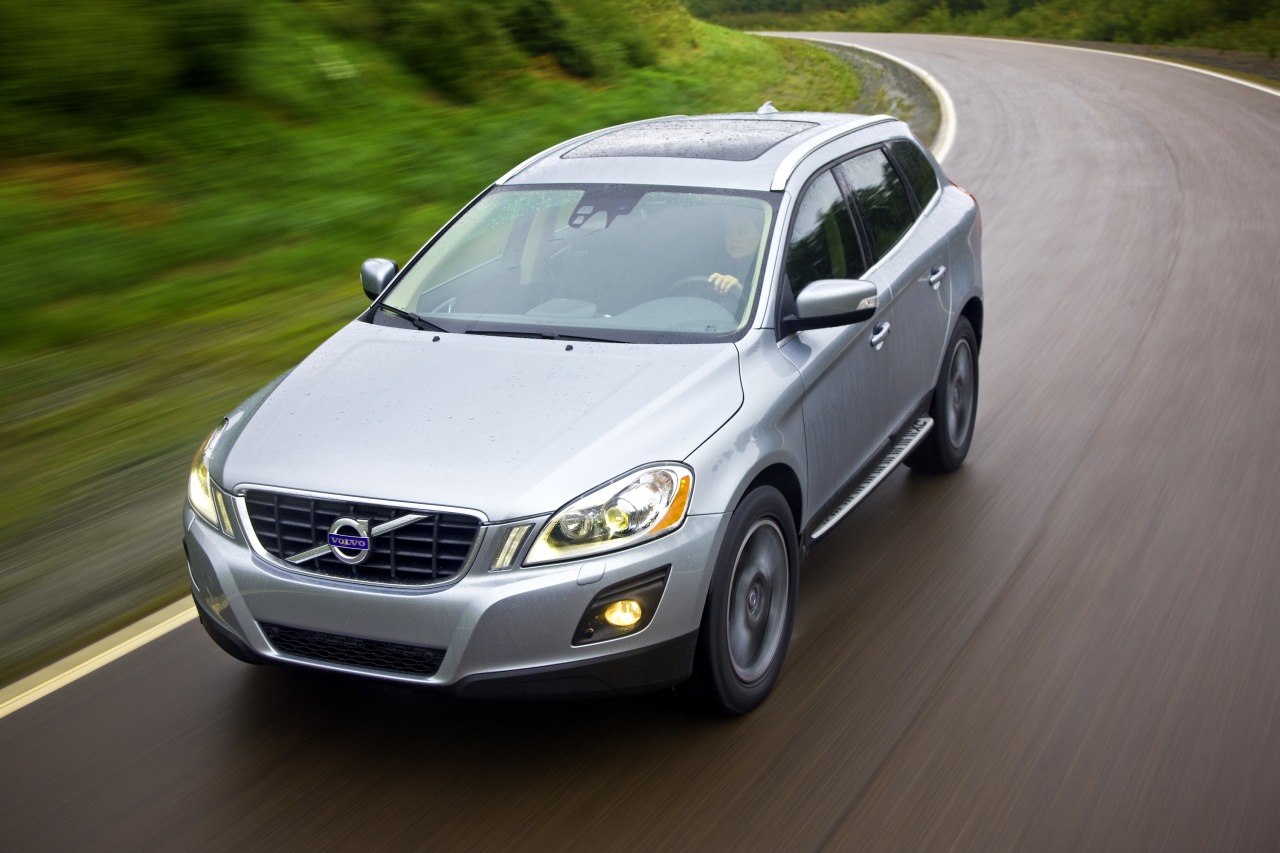 UK MY2010 vehicles include 2.4D, D5, and T6 engines. During mid 2010 the 2.4D unit was discontinued and replaced with two new D3 engines. 2.0L for FWD and 2.4L for AWD. US models include 3.2 FWD and T6 AWD. Canada models include 3.2 FWD, 3.2 AWD, and T6 AWD. Australian models include 3.2 AWD, D5 AWD and T6 AWD. The DRIVe (Auto) models feature stop/start technology. All diesel engines feature particulate filters. AWD models include Haldex Traction (Version 4) AWD with Instant Traction. All US models have only 6-speed Geartronic transmissions. Canadian models have only 6-speed automatic transmission for 3.2 FWD and 3.2 AWD. The T6 AWD includes a 6-speed Geartronic transmission. The XC60 includes traditional Volvo safety features including a whiplash protection system, side impact protection system, roll stability control, dynamic stability and traction control, inflatable curtain airbags, hill descent control (AWD only), collision warning with brake support, active bi-xenon lights (optional on some models), and patented front, side, and rear structures. The XC60 also introduced a new technology feature that Volvo has named City Safety. The system is described as a driver support system with the goal of preventing or mitigating vehicle-on-vehicle collisions below 30 km/h (19 mph); it does so through the use of a closing velocity sensor that helps determine whether a collision is likely. Depending on the speed, if a collision is likely, the Volvo's computer system will either prepare the car to brake or automatically brake the vehicle to avoid or mitigate a rear-end collision. Volvo also implemented the system to assist in towing caravans and trailers. EuroNCAP evaluated the XC60 in 2008, awarding it 5 of 5 stars for adult occupant protection. The XC60 scored 16 of 16 points in the front test and 16 of 16 in the side test. The car received 2 of 2 points available in the pole test and an additional 3 points available for seat belt reminders. The XC60 received a total of 37 of 37 points and therefore five stars (33-37) in EuroNCAP's evaluation. The XC60 was one of only three cars (Nissan Qashqai, 2008-onward Renault Megane) to receive 37 of 37 available points under EuroNCAP's point based evaluation. The Insurance Institute for Highway Safety awarded the Volvo XC60 their Top Safety Pick award. The XC60 was granted the IIHS's highest rating of "good" in front, side, rear and roof strength tests and has Electronic Stability Control as standard equipment to receive the award.
 Elegant Black Volvo XC60
 Volvo XC60 Machine View
 Volvo XC60 With High Technology
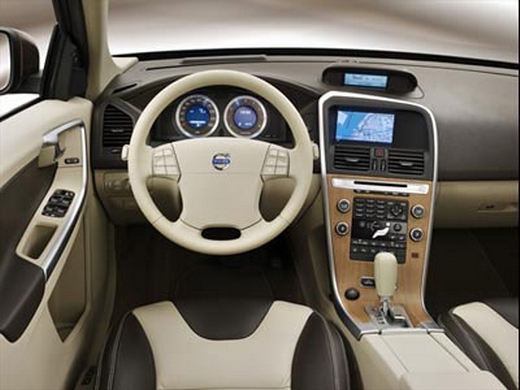 Volvo XC60 Steering Wheels
 Volvo XC60 Seat View
 Exotic Red Volvo XC60
 The Renault Espace is a large MPV from French car-maker Renault. Generations 1-3 were sold under the Renault brand but manufactured by Matra. The current fourth generation model, which seats seven passengers, is an all-Renault product; the Renault Grand Espace is a long-wheelbase version with increased rear leg room and boot size. The Espace is often credited as being the world's first MPV (a claim Renault themselves encourage). However, the 1950 Volkswagen Type 2, also known as the Kombi, and the 1956 Fiat 600 Multipla, popularised the versatile multi-seater concept some 30 years prior to the Espace, and the concept had been tried several times before that, an early example being the 1935 Stout Scarab. The Espace's design was originally conceived in the 1970s by the British designer, Fergus Pollock, (at around the same time as Giorgetto Giugiaro's 1978 Lancia Megagamma concept MPV), who was working for Chrysler UK (formerly the Rootes Group), at their design centre at Whitley, (now the Jaguar design centre) in Coventry. Later Matra, who were affiliated with Simca, the then French subsidiary of Chrysler, were involved in partnership in the design, spearheaded by Greek designer Antonis Volanis. The Espace was originally intended to be sold as a Talbot, and to be a replacement for the Matra Rancho leisure activity vehicle. Early prototypes used Simca parts, and hence featured a grille reminiscent of the Simca 1307 (Chrysler Alpine). The Espace was launched by Renault in 1984. After a very slow start — a grand total of nine Espaces were sold in the first month after launch — customers warmed to the benefits of the MPV concept and the Espace became very popular.

 Building upon its success, the Espace was revamped in 1988 with most of the Talbot/Simca content being replaced by equivalent Renault parts (the chassis and mechanical components of the car remained largely unchanged). The most obvious cosmetic exterior difference between the very first Espaces and the revamped post-1988 models were the changed headlights: the forward-slanting lights with orange indicator casing of the original Espace were replaced with backward-slanting lights with a clear indicator casing.A heavily revised Espace was launched in 1991, adopting the Renault family look to replace the Talbot-themed styling of the original. This was essentially a re-skin of the original car, with a new dashboard and other interior improvements. The chassis was essentially unchanged. The third generation of the Espace arrived in 1997 while the long wheelbase Grand Espace appeared the following year, its most notable feature being the radical futuristic interior (with a centrally-mounted digital speedometer). A number of third generation Espaces were used as bases for NGV and taxi conversions for the Kuala Lumpur International Airport and the Kuala Lumpur Sentral transportation hub in Malaysia, rebranded as Enviro 2000s. The third-generation Espace was the last to be built by Matra; following an end to production for Renault, Matra and MG Rover negotiated over a possible deal for the latter to build and market Espaces but this never came to fruition.
 The fourth-generation Espace arrived in 2003 and was the first entirely Renault-developed and produced model. The Espace is 90% recyclable and contains numerous weight-reducing materials, thus cutting fuel consumption. The aluminium doors and bonnet are some 20 kg lighter than steel equivalents. Its styling was reflective of a new design direction at Renault, symbolised by the radical Vel Satis and Avantime models, marking a major departure from the previous model, which also saw the range moved upmarket. The fourth-generation Espace came third from the bottom in the Top Gear Satisfaction Survey 2005. The 2003 Espace featured in British motoring TV show Fifth Gear where it was crashed into a 1990s Land Rover Discovery at 64 km/h (40 mph). The passenger compartment in the Espace was kept fairly intact, but the dummy in the Discovery was smashed between the seats and the dashboard, leaving no survival possibilities.The Espace V is estimated to arrive in 2011. It is likely to again be closely related to the Renault Laguna sharing chassis, engines, transmissions and electricals and will be presented at the 2011 Frankfurt Motor Show.
 Red Elfin Cars
 Unique Elfin Cars Design
 Elfin Cars Streamline
 Side Elfin Cars
 Sporty Black Elfin Cars
 Elfin Cars Hatchback
 Elfin Cars Back View
