Infiniti Qx56

The Infiniti QX is a luxury SUV built by Nissan and originally sold in North America. The first generation received its naming inspiration from the recognized four wheel drive terminology "4×4" with Infiniti adding a "Q" at the beginning to suggest it was a luxurious "4×4", borrowed from the Q45. The first generation also had a briefly available Japanese version called the Nissan Terrano Regulus. Consecutive generations are much larger, and the naming convention adheres to the current trend of using a numeric designation derived from the engine's displacement. The Infiniti QX4 is a mid-size sport utility vehicle (SUV) introduced in 1997 as a rebadged Nissan Pathfinder. It was released a year after Acura's introduction of the SLX and Lexus's larger LX 450. The QX4 was Infiniti's first entry into the SUV market segment. In the North American market, it was marketed as the "Infiniti QX4" while in Japan it was sold as the Nissan Terrano Regulus. Major differences between these vehicles and the Pathfinder include a more advanced four wheel drive system, a more upscale interior, and unique styling. Although marketed as a luxury vehicle, it is capable off-road service due to its low-range four wheel drive system and 8.3 inches (211 mm) of ground clearance. The QX4 received its first major update in 2001, with a new VQ series engine (also later seen in the G35 and FX35) increasing its power from a relatively low 168 horsepower (125 kW) to a 240 hp (179 kW) V6 engine. The displacement went from 3.3 L to 3.5 L. The timing belt was replaced with a timing chain and the ignition distributor was replaced with an individual coil ignition system. This 2001 facelift also gave the QX4 an updated exterior and interior body style, including features such as a new dash with integrated analog clock, 17-inch (423 mm) alloy wheels and xenon HID headlamps. In Japan, the Terrano Regulus trim package was no longer offered. Also, a rear-wheel drive model was added (1997 through 2000 were only available in 4WD).

The Infiniti QX56 is a full-size sport utility vehicle (SUV) sold under the Nissan-owned Infiniti luxury brand. It is based on the Nissan Armada full-size SUV, and shares the F-Alpha platform with the Nissan Titan pickup truck. The QX56 is currently unique to the United States, Canada, Russia, Bahrain, UAE, Kuwait and Saudi Arabia. It was also the first Infiniti built in the United States. The rear door handles are installed on the "C" pillar as a Nissan design tradition started with the 1986 Nissan Pathfinder. When the four door Nissan Pathfinder was introduced, Nissan chose to conceal the door handles as a part of the "C" pillar trim to visually make it appear like a two door truck with a camper shell, with conventional door handles on the front doors. The truck is propelled by a 5.6 L VK56DE V8 engine (315 hp [227 kW] @ 4,900 rpm and 390 lb·ft (529 N·m) torque @ 3,600 rpm) and a 5-speed automatic transmission with an overdrive. As is common with aluminum blocks, each cylinder in the engine is lined with cast iron. The valvetrain is a DOHC design with four valves per cylinder. Infiniti designed the QX56's throttle responsiveness to correspond to specific drivetrain modes: when the driver selects all-wheel drive, the throttle becomes less sensitive, presumably to allow easier regulation of acceleration when off-road. The Infiniti QX56 has around 9,000 lb (4082 kg) of towing capacity. Mileage at peak performance drain is 12 miles per US gallon (20 L/100 km; 14 mpg-imp). It comes in one trim level, with only key options such as: DVD entertainment system, 4WD/2WD, and a bench instead of captain chairs as the second row. Other features which come standard are a ten-speaker Bose system, DVD-based navigation system, leather trim for all seats, dual-climate control, 18-inch chrome alloy wheels, and an adaptive cruise control system. A pre-crash system is a novelty in the market as well. On March 31, 2010, Infiniti debuted the 2011 QX56 at the New York International Auto Show. The QX56 is a complete redesign of the QX. The QX56 features a new VVEL certified 5.6 L VK56VD V8 engine. The new V8 which is also found in the Nissan Patrol is rated at 400 horsepower (300 kW) and 413 ft·lbf (560 N·m) of torque.The more powerful engine helps give the QX an increased towing capacity of up to 8,500 pounds. The engine is tied to a seven-speed sequential-shift automatic transmission with an all-new 4WD system which has different all setting. Compared to its predecessor, the new QX is 1.4 inches longer, 1.1 inches wider. Most of the frame's body mass is made from high-tensile steel, but the QX manages to be more rugged with its body-on-frame concept and it shares the same platform as the Nissan Patrol. Both the front and rear feature independent suspension double wishbone suspensions combined with the new Hydraulic Body Motion Control System. The QX comes standard with 22-inch wheels. A 4-setting terrain control which includes rock, snow, sand and dirt for 4WD versions. This generation abandoned the disguised rear door handles that were installed in the "C" pillar, a tradition started with the 1985 Nissan Pathfinder 4-door, as the first generation QX was based on the second generation Pathfinder. This generation appearance is more in line with other large luxury SUVs like the Lexus LX, Range Rover, Cadillac Escalade, and Lincoln Navigator. The QX's interior design includes a number of the standard and optional amenities featured in the 2010 Infiniti M, such as semi-aniline leather seats, four-zone climate control, a Bose 2-channel, 13-speaker Premium Audio surround sound stereo system with hard drive memory storage, a hard-drive based navigation system, XM satellite radio with NavTraffic is standard, a power liftgate/tailgate, and Infiniti Intuitive Park Assist, a parking assist feature which uses the around view monitor. Other features include climate controlled front and rear seats, streaming audio via Bluetooth wireless technology, a center console cooler for storage of cold drinks which can be accessed by both front and rear passengers, power sliding rear seats, power third row seats, and a 7-inch DVD rear-seat entertainment system. Curtain Vent, new for this generation, directs air flow from the air conditioning system from above each side window down towards the floor. A new Around View Monitor system uses a camera mounted on the grill giving a 180 degree view in front and another camera mounted on the passenger side of the vehicle's side mirror helps eliminate blind spots on the side at low speeds such as when in parking lots or on off-road adventures.

Elegant Black Infiniti Qx56

Infiniti Qx56 Sound Stereo

Beautiful Inside Of Infiniti Qx56

Infiniti Qx56 Steering Wheels

Infiniti Qx56 Hatchback

Luxury Infiniti Qx56

Suzuki Xl7

The Suzuki XL-7 is Suzuki's mid-sized SUV, launched in 1998.The first-generation XL-7 was a Suzuki design and was essentially a stretched Grand Vitara. It had a Suzuki-designed 2.7 liter V6 on a rear wheel drive-based platform with optional four wheel drive. When introduced, the XL-7 was the least expensive SUV available with 3-row seating in North America. The Suzuki XL-7 sold over 20,000 a year, and was awarded the Consumer's Digest Best Buy award. However, sales slowed as competitors came out with SUVs with more features, lower prices, better fuel efficiency and more powerful engines, such as the Toyota Highlander, the Honda Pilot, and the Honda CR-V.A unique trait in the U.S. market in this segment, the XL-7 was available with 5-speed manual transmission, in both 5-person and 7-person variants. Introduced in the fourth quarter of 2006, Suzuki partnered with General Motors to build the 2007 model, now called XL7 (without the hyphen). It uses the same unibody platform and many of the same components as the Chevy Equinox, Pontiac Torrent and Saturn Vue, but incorporates third row seating exclusive to the Suzuki. The second generation model uses a version of the GM High Feature engine, built in Japan and shipped to CAMI Automotive in Ingersoll, Ontario, Canada, where the XL7 is assembled with the Equinox and Torrent, and also the second-generation Suzuki XL7 is Suzuki's first entry in the crossover SUV segment. Styling cues on the 2007 include a chrome slotted grille and trapezoidal headlights.In May 2009, Suzuki halted production of the XL7 indefinitely due to low demand. Through May 10, 2009, CAMI Automotive Inc. had only produced four XL7s for Suzuki after producing more than 12,000 units last year.

The all-new XL7 was designed to blend SUV versatility and safety with increased driver and passenger comfort," said Koji Yamada, chief engineer, XL7. "The XL7 not only offers the cargo and seating flexibility for all aspects of a consumer's active lifestyle, but performance capabilities and safety features that give them the confidence of being in control. The all-new 2007 Suzuki XL7 evolves from a rear-wheel-drive, truck chassis SUV into a crossover SUV based on the sophisticated GM Theta platform with full-length underbody rails for added strength. The XL7 is now a front-wheel-drive vehicle that features four-wheel independent suspension and available all-wheel drive. The standard powertrain for the Suzuki XL7 is a GM-designed, Suzuki-built 3.6-liter, V6 DOHC engine rated at an estimated 250 hp with 243 lb-ft of torque. The XL7's 3.6-liter, High Feature (HF) engine with variable valve timing will be built under license by Suzuki in Japan using Suzuki engine-building technology at the Sagara engine plant. The XL7 engine was developed as a joint effort between Suzuki and GM engineering and features unique Engine Control Unit (ECU) calibration. The use of the existing platform architecture accelerated the completion of the vehicle, which has been in development for three years. The 3.6-liter, six-cylinder, DOHC engine is matched to a five-speed automatic transmission that features a manual-shifting (manumatic) mode. Although the new engine is nearly one liter larger than the 2.7-liter engine used in the previous XL-7, the new, larger XL7 was designed to deliver fuel economy equal to or better than its predecessor. EPA fuel economy estimates are 18 mpg/city and 24 mpg/highway for front-wheel-drive variants and 17 mpg/city and 23 mpg/highway for all-wheel drive. Towing capacity is rated at 3,500 pounds.

The sophisticated chassis delivers nimble, car-like ride and comfort whether driving on the highway, city streets or rural roads. The XL7's responsive road manners communicate a sense of confidence and control in virtually every driving scenario, while still providing refined Noise, Vibration and Harshness (NVH) performance at or near the top of the midsize SUV category. The XL7 features four-wheel independent suspension with MacPherson struts in the front and a multilink design in the rear. The independent rear suspension is fitted with hydraulic shock absorbers in the five-passenger configuration and Nivomat self-leveling rear shock absorbers when configured for the available seven-passenger design. The all-new XL7 is fitted with a true dual exhaust system, constructed of durable, long-lasting stainless steel. The system was designed for quiet, refined exhaust tones to achieve "best in class" NVH in terms of quietness and tonal quality. The exhaust system features two downpipes, two catalytic converters, a center muffler, two side mufflers and two 3.5-inch diameter exhaust tips.The XL7's safety features start with the body structure itself -- a combination of computer-designed high-strength, dual-phase and galvanized steels. The body structure is computer-designed to manage loads -- to effectively transfer energy absorbed during impacts around the interior compartment and occupants -- in both front and rear crashes.The unibody construction is a high-strength steel structure, incorporating full-length frame rails and a safety cage in the middle into a single, welded unit. It also is designed with front and rear crush zones engineered to collapse in a controlled manner to help absorb crash energy while protecting the integrity of the occupant safety cage.The safety cage is reinforced with welded, tubular-section members that frame door openings and support the roof and steel members in the doors. The combination of single-piece door aperture and door beam reinforcements help resist side-impact intrusion.

Daewoo Lacetti

The Daewoo Lacetti is a compact car made by the South Korean automaker GM Daewoo since 2002. The first-generation Lacetti was available as a four-door sedan, a five-door hatchback or a five-door station wagon. The sedan and wagon were designed by Pininfarina, and the hatchback by Giorgetto Giugiaro. The hatchback, known as Lacetti5 in South Korea, was introduced in summer 2004. In November 2008 the second-generation Lacetti was launched under the name Lacetti Premiere, being a badge-engineered version of the Chevrolet Cruze - though co-developed by GM Daewoo and Chevrolet. In South Korea, the 4-door Daewoo Lacetti was released in 2002. The 5-door hatchback showed off only after the 2004 facelift of the sedan, which mainly included a new front grill, switching from a three-part corporate Daewoo grill to a simpler, Chevrolet-style grill. The hatchback name was Lacetti5, offering a specific design for the front, rear and dashboard. The wagon version, called simply Lacetti Wagon, was introduced in late 2007 - strangely as it was already sold in many other countries. It had the same dashboard than the hatchback, with the sedan front end. At the same time, GM Daewoo introduced the VM Motori Diesel engines on the Lacetti range. When the Lacetti Premiere was introduced in November 2008, the sedan and wagon version sales were discontinued, leaving the only hatchback in the range, renamed Lacetti EX. The Lacetti EX was discontinued in October 2009. In Australia and New Zealand, the Daewoo Lacetti was briefly sold between 2003 and 2004 as a four-door sedan. During the 'Asian Economic Crisis', Daewoo became technically insolvent and the company withdrew from the Australian market. From 2005, the Lacetti (sedan and wagon) and Lacetti5 were sold together as the Holden Viva. It was introduced at around the same time as the Daewoo Gentra-based Holden Barina. Unlike the current Barina, however, the Viva was meant to be below the premium Holden Astra as a budget alternative. Despite the Viva's lower price compared to the Astra (A$17,990 compared to A$21,990), the Astra continued to outsell the Viva by a factor of about two-to-one. With the release of the all new Holden Cruze in mid 2009 the Viva ceased to be sold in Australia. The Lacetti was available in Canada as the Chevrolet Optra in two models, a four door hatchback (the Optra5), and an Optra Wagon, all in LS or LT trim levels (2005 Wagon only had Base or LS trim levels) . The sedan was available in 2004 and 2005, but was removed in 2006. All are powered by the 2.0 L inline-4 D-TEC engine, rated at 119 hp (89 kW) at 5400 rpmand 126 ft·lbs (171 N·m) of torque at 4000 rpm, driving the front wheels through either a 5-speed manual transmission or a 4-speed automatic. Despite its compact size and the 2.0L engine, fuel economy was poor rated at 10.7L/ 100 km for city and 7.4 for highway driving which was worse than midsize cars like the Toyota Camry or Honda Accord, considering that the Optra was a compact car.


GM Daewoo Lacetti (Nubira) Commercial

In China, the cars are marketed as the Buick Excelle sedan or wagon and Excelle HRV (hatchback). The sedan, which is also assembled in China, features an updated exterior. GM confirmed the Excelle's successor at its extended product review in August 2009. The car will be based on the Chevy Cruze and will also be sold in the U.S. The second generation hatchback (Excelle XT) made its debut in 2009 while the sedan (Excelle GT) made its debut in 2010.In Europe, the car was initially sold as the Daewoo Nubira, with the production model being introduced at the Frankfurt Motor Show in September 2003. However, by the end of 2004, it was rebadged Chevrolet Lacetti throughout the continent. As with its home market, in some European markets, the Lacetti name is also used for the entire range of sedan, station wagon and hatchback models on the same J-series platform. In Finland and Germany, for example, only the hatchback is sold under the Lacetti name. In 2002, The Lacetti is manufactured in India and sold as the Optra and the hatchback version is sold as the Chevrolet Optra SRV (formerly known/sold as Chevrolet SRV), which they plan to get out with a 2L diesel engine in the near future. The Optra is sold with two engine options, 1.6 L and 1.8 L. In the first option it is available in three trim levels, the Elite, the Elite LS, and LT Royale. In the second engine option it is available in two levels, the LT and the LT AT, the latter coming with automatic transmission. In 2007 GM India came out with a diesel engined Optra called the Optra Magnum. The Magnum had a different nose, and interiors as compared to the petrol version. Subsequently the petrol version got the new nose treatment(like that of the Optra SRV but with a slightly different front grill) and tail lights, and are sold as Optra Magnum petrol/diesel. In Pakistan , the car comes in three trim levels, 1.6L SE, 1.6L LS and 1.8L CDX. SE trim comes in manual transmission only, while LS and CDX trim come in 5 speed manual or 4 speed automatic transmission.In Japan, Suzuki briefly distributed the Lacetti as the Chevrolet Optra Wagon. It was available in two trim levels, the LS and the LT. Both came with either a 5-speed manual or 4-speed automatic transmission with a console shift. The Optra Wagon was powered by a 1.6 L or 1.8 L engine.

In Mexico, the Lacetti came to the market in 2006 as Optra to replace the Chevrolet Cavalier, and it was sold only as a sedan. The Optra was phased out after the 2009 model year in favour of the Chevrolet Cruze, although for now, the Mexican Cruze is an imported model from South Korea. As the United States and Canada got the Lacetti for the 2004 model year, Mexico got the car 2 years later, making Mexico the last North American country to get the car.In Singapore, Chevrolet replaced the Daewoo nameplate after GM bought Daewoo. It still offers the same line-up than GM Daewoo, naming the Optra sedan, Optra station wagon and Optra5 hatchback in Malaysia, Thailand, and the Philippines. In Indonesia, the sedan is simply called Optra or Optra Magnum for the facelift model, and Estate for the station wagon. The vehicles use the 1.6 L or 1.8 L engine with an automatic transmission available for selected models. Suzuki marketed a rebadged Lacetti as the Forenza and Reno beginning in the United States in 2004 — following the end of Daewoo's North American operations in 2002 and replacing the Daewoo Nubira station wagon and sedan. The Forenza/Reno falls between the Aerio (later SX4) and the now-discontinued Verona. In the territories of Guam and Northern Mariana Islands, it was sold as a Chevrolet Optra, but it was only available as a sedan. The US model line features the 2.0 L 4-cylinder E-TEC II made by Holden, developing a maximum power of 126 horsepower (94 kW) at 5600 rpm. Automotive News says the Forenza and Reno will be discontinued within the 2008 model year, and the Reno has been replaced by the Suzuki SX4 sedan after the 2008 model year. The 2010 Suzuki Kizashi, a large compact sedan, replaced the Forenza. It is sold as the Chevrolet Lacetti and includes 5-door hatchback, sedan and station wagon models. The entire line of models are produced at the Avtotor plant in Kaliningrad with full cycle of manufacturing.The second-generation, known as the Lacetti Premiere in South Korea, built on the GM Delta II platform is sold in most markets as the Chevrolet Cruze.This model is known as the Chevrolet Lacetti in the United Kingdom and is available in Hatchback or Estate body styles. It is very similar to the older model and shares many parts, including the bonnet, headlamps and front bumper. The Chevrolet Lacetti was picked as the new "reasonably-priced car" in Top Gear's "Star in a Reasonably-Priced Car" segment for season 8 in 2006, replacing the Suzuki Liana, which had ceased production. In this segment of the show, celebrity guests set timed laps of the Top Gear test track driving the Lacetti. In the first episode of series 15 of Top Gear, broadcast on BBC2 on 27 June, the Lacetti that was used for the power laps was given a 'Viking Burial' by presenter Richard Hammond when an industrial chimney was demolished, knocking it over and burying the Lacetti in the process. Soon afterwards, the new reasonably priced car (a Kia Cee'd) was unveiled to the audience.

Buick Envision

New Exotic Buick Envision For 2011

Impressive Buick Envision

Buick Envision Interior View

Buick Envision Seats Concept

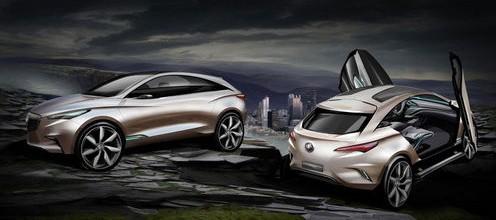
Buick Envision Concept

Buick Envision Side View

Buick Envision Hatchback

Renault Twingo

The Renault Twingo is a city car built by French automaker Renault, first presented at the Paris Motor Show in September 1992 and sold in continental European markets beginning in 1993. The second generation Twingo was launched in Summer 2007. The "Twingo" name is a portmanteau derived from the words "Twist", "Swing" and "Tango". The Twingo was designed under Patrick le Quément, Renault's chief designer. Le Quément's belief was that it was a greater risk for Renault to take no risks at all, having seen its market share suffer from cars such as the Renault 9 and 11. The design of the Twingo resembles that of the 1982 Polish prototype Beskid, from which its monobox silhouette is claimed to be derived. The Twingo has been built since its launch in France in 1992 and in Colombia and Uruguay from 1995 to 2008, undergoing three intermediate restylings in 1998, 2000 and 2004 — solely as left-hand drive models in its first-generation and not sold in most RHD markets. Production of the first generation model ceased at the Flins factory in France on 28 June 2007. It is, however, still produced in Colombia by the Sofasa conglomerate. for the South American market. Total production up to 30 June 2007 was 2,478,648.

The Twingo featured revolutionary features (at the time of launch) of a centrally mounted instrument panel, consisting of a speedometer, fuel gauge and clock, with the odometer and trip recorder selected by pushing a button on the end of the steering column stalk. This left just a strip of warning lights in the area behind the steering wheel. It also had a sliding rear seat, which could be moved to either increase boot space or rear seat legroom. The boot parcel shelf was also unusual in that it was attached to the inside of the tailgate, and lifted up with the tailgate. It could also be clipped back against the rear window when not required. All the first-generation Twingos were equipped with straight-4 petrol engines. Initially available with an 8-valve 1.2-litre 55 hp (41 kW) engine, it was replaced with an 8-valve 1.15-litre 60 hp (45 kW) unit. A 16-valve 75 hp (56 kW) version was added in 2000. Many parts (e.g. the JB1 gearbox, brakes, engine, window switches and seats) are shared with other vehicles across the Renault range. A concept was presented at the 2006 Mondial de l'Automobile. The production version was presented at the 2007 Geneva Motor Show after a last minute redesign was ordered. The model is based on the floorpan of the Renault Clio Mark II, with significantly improved strength and crash protection. Production was transferred from France to the Novo Mesto plant in Slovenia (Revoz). It went on sale in France, Italy and Slovenia on 15 June 2007, and in the rest of Europe, including the UK and Ireland, on September 4, 2007. The motoring press in the UK have criticised the new Twingo for being rather unadventurous in style and appearance compared to the original. The petrol engine is a 1.2-litre unit in three versions, an 8-valve 60 hp (45 kW) naturally aspirated, a 16-valve 75 hp (56 kW) naturally aspirated and a 16-valve 100 hp (70 kW) turbocharged version. The diesel engine is a 1.5-litre 65 hp (48 kW) dCi unit. Trim levels for the French market starts with the un-named base model followed by Authentique, Expression, Initiale, Dynamique and GT. On 31 January 2008 Renault announced the Twingo Renaultsport, with a new 133 hp (100 kW) 1,598 cc engine and Renaultsport styling. Its first public outing was at the 2008 Geneva Motor Show and the first cars were shipped in late 2008.

The second generation Twingo is also available in right hand drive markets such as the United Kingdom and Japan. Engines available in the UK are the 75 hp (56 kW) in Dynamique trim level and 100 hp (70 kW) petrol units, in GT trim level. A 60 hp (45 kW) engine, in a cheaper Extreme trim level was released in January 2008, and the Renaultsport 133 hp (100 kW) went on sale in September 2008. In February 2009, a new model, called Freeway will be introduced, below the current Extreme model, but with the same 60 hp (45 kW) engine. In summer 2010, the Freeway and Extreme were renamed in the UK markets to the Expression and i-Music respectively; these were given new interiors and changes to some of the exterior, including new rear bumpers and wing mirrors. A convertible version, called Wind, was launched at the 2010 Geneva Motor Show. On series 14 episode 4 of Top Gear, presenter Jeremy Clarkson did an unusual road test of the Twingo 133 on the streets of Belfast, Northern Ireland. During the segment, Clarkson drove it through a sewage tunnel in an attempt to run it upside down, which he managed to do as part of a barrel roll. After subjecting it to numerous "accidents", he raced the battered car in an attempt to catch a departing ferry, only to crash it into the ocean. On 16 March 2011, the Renault Twingo won the "best city car award" in the Parkers' New Car Awards. The current Twingo is scheduled to be facelifted in 2012. The Renault Twingo In Special Editions are :
* Twingo Renaultsport Gordini: A Twingo Renaultsport with Gordini branding available in Gordini trim level in Pearlescent Black or Malta Blue. Only 200 available in UK markets. Went on sale in the Spring/Summer of 2010.
* Twingo Gordini TCe 100: An affordable version of the RS Gordini. The Gordini 100 features the 1.2 TCe engine (as in non-Renaultsport models) and full Gordini branding, available in Pearlescent Black or Malta Blue. This model was introduced in the latter of 2010.
* Twingo Bizu: Based on the Authentique (EU)/Expression (UK)) model using the same 1.2 TCe engine. A limited edition trim featuring new front bumpers, Bluetooth and a new headunit/stereo. This model became available early 2011.

Fiat Sedici

The Fiat Sedici is a mini sport utility vehicle co-developed by Fiat and Suzuki mainly for the European market. It was introduced at the 2006 Geneva Motor Show, and is built at the Magyar Suzuki plant in Hungary. The expected production volume is 60,000 units per year, 1/3 of these to be sold by Fiat and 2/3 of these to be sold by Suzuki, where it is badged as the SX4. The design was created by Giorgetto Giugiaro's Italdesign Giugiaro studio, and it is an alternative to mini multi-purpose vehicles (MPV), which have a more "boxy" appearance. Introduced by Fiat in December 2005, it was the official car of the 2006 Winter Olympics. As the car is four wheel drive, it is considered a 4x4. As 4x4 is 16, the car is named Sedici, which means "sixteen" in Italian. By pressing a button the driver can change between 4x2 and 4x4 transmission modes. The car also has electronic stability control (ESC) on the options list and a diesel particulate filter (DPF) is a standard feature. In November 2006 it was the second best selling SUV in the Italian market, and by June 2007 it was the best selling vehicle. The front wheel drive version of the Sedici was unveiled in spring 2008. It was available with the same engine choices as the 4X4 version and was available in two trim levels: Dynamic and Emotion. The price, in Italy, was around 2000€ cheaper than the 4x4 version.There are two engines available: a 1.6 L Suzuki petrol and a 1.9 L Fiat turbodiesel.In spring 2009, the Sedici was given a more substantial upgrade: A changed front grille, similar to that of the Bravo, and a new bumper. Inside it has more sophisticated instrumentation, new fabrics, the air conditioning vents were changed, and it has new Euro 5-compliant engines. The 1.9 litre Multijet engine was replaced by the more modern 2.0 litre Multijet engine 135 PS (99 kW; 133 hp), also the petrol 1.6 litre engine was upgraded to have 120 PS (88 kW; 118 hp), with lower fuel consumption.

Elegant Fiat Sedici

Fiat Sedici Hatchback

Fiat Sedici On The Road

Active Fiat Sedici On Snow White

Fiat Sedici Steering Wheels

Fiat Sedici Seats View

Honda Accord Crosstour 2011

The 2011 Honda Accord Crosstour is the best car for you if you want a friendly galoot of a four-door hatchback that drives far better than meets the eye. The 2011 Honda Accord Crosstour gets a slightly rearranged dashboard layout but otherwise carries over unchanged. The 2011 Crosstour represents the sophomore edition of a radical Honda that turns the Accord sedan into a new-age crossover SUV station wagon. Priced in the $31,000-$37,000 range, Crosstour seats five in roomy comfort and is available with all-wheel drive (AWD). Honda calls this bulbous-tail fastback a “crossover utility vehicle” and bravely casts it as the flagship of the Accord line. The 2011 Accord Crosstour is aimed at taste-makers who have a family and don’t want a three-row SUV. There apparently are not legions of those folks in the market for a new car – Crosstour sales have been modest. Wait for the 2012 Crosstour if you’re keen on a four-cylinder version and want to roll the dice that Honda will introduction one for model-year 2012. The 2011 Crosstour comes only with a V-6. That helps keep its starting price several thousand dollars above that of its closest rival, the Toyota Venza, which offers both four- and six-cylinder engines and handily outsells the Crosstour. Buy the 2011 Accord Crosstour if you’re not in a gambling mood and envision a role in your life for this atypical but appealing stew of automotive genres. Barring introduction of a four-cylinder model, the 2012 Accord Crosstour isn’t expected to gain any features worth waiting for, though it could represent the final year before Honda treats this crossover to freshened styling.


The 2011 Honda Accord Crosstour’s styling is a carbon copy of the 2010 model’s. Crosstour is a four-door hatchback with a trendy coupe-like roofline. It’s based on the underbody structure of the midsize Accord sedan and shares the car’s basic dashboard design and cabin décor. Crosstour doesn’t have an SUV-tall step-in height but does ride higher than the Accord sedan and has a more commanding seating position. Its wheelbase – the distance between the front and rear axles – is virtually identical to the sedan’s. And though the body bears an Accord-family resemblance it’s designed to convey a more powerful presence. Crosstour is slightly wider and longer than the Accord sedan and is a significant 8 inches taller, for much more interior volume. This is a commodious passenger compartment outfitted in high-quality materials. Crosstour’s hatch lid lifts to reveal 25.7 cubic feet of nicely finished cargo space, double the volume of Accord’s trunk. Crosstour has 51.3 cubic feet with the 60/40 split rear seatbacks folded, but similarly sized competitors with less-slanted tailgate shapes, such as the Toyota Venza and Subaru Outback, have more than 60 cubic feet of cargo space. In the only model-year 2011 change, Honda slightly reconfigures the central portion of Crosstour’s dashboard, moving some of the more frequently used climate controls – defroster buttons, for example – closer to the driver and creating a more compact audio array. It’s a minor but welcome change that more logically groups Crosstour’s rather abundant number of switches and knobs. The 2011 Honda Accord Crosstour continues with a three-model lineup: EX, upscale EX-L, and top-of-the-line EX-L with navigation, which Honda calls the EX-L Navi. The only styling distinction is that the EX has 17-inch alloy wheels and the EX-Ls have fancier 18-inch alloys. Fuel-economy ratings for the 2011 Honda Accord Crosstour get a slight bump over their 2010 ratings. With front-wheel drive, the 2011 Crosstour remains rated at 18/27 mpg city/highway. With AWD, the 2011 Crosstour is slightly more fuel efficient than its 2010 counterpart at 18/26 mpg compared to 17/25. The Crosstour runs on regular-octane gas.


Crosstour borrows Accord’s most powerful engine and fortifies its suspension to support an additional 300 pounds of curb weight (an additional 500 pounds with AWD). A four-cylinder engine isn’t consistent with Honda’s initial positioning of the Crosstour, so the 2011 model returns with a 3.5-liter V-6 as its sole engine. It has 271 horsepower and 254 pound-feet of torque and is equipped with Honda’s Variable Cylinder Management system, which automatically runs it on three or four cylinders to save gas in low-demand cruising. Honda reserves six-speed automatic transmissions for cars from its premium Acura division, leaving the 2011 Crosstour to repeat with a five-speed automatic. This transmission lacks manual-gear-control via a separate shifter gate or steering wheel paddles but does benefit from Honda’s new shift-logic programming for better engine-speed management, particularly during cornering. Like the Accord, Crosstour has front-wheel drive, but unlike the car, it’s available with all-wheel drive. While Venza makes AWD available even on its lowest-priced four-cylinder model, Honda reserves it as an extra-cost feature for the top-line Crosstour EX-L. Typical of a crossover AWD system, Crosstour’s defaults to front-wheel drive but can automatically shuffle power between front and rear wheels to sustain traction. Crosstour has an SUV-credible 8.1 inches of ground clearance (a couple of aero-enhancing plastic tabs below the front bumper hang lower), but it isn’t designed for off-road use. Towing capacity is a modest 1,500 pounds. In all, Crosstour drives and rides like the slightly inflated Accord that it is – and that’s a good thing. Alert V-6 acceleration and athletic road manners distinguish Accord among midsize sedans and the same virtues help Crosstour drive with more precision than midsize crossovers with more conventional-SUV styling and the taller center of gravity that entails. Factory options are not part of Honda’s marketing strategy. The carmaker instead equips each model in a lineup with a specific set of features based on careful study of buyer preference. The policy simplifies assembly and therefore promotes quality, though it does compel Honda shoppers to sometimes climb the model ladder to acquire a desired feature – and in the process, pay for items they might not otherwise have purchased. The 2011 Honda Accord Crosstour doesn’t deviate from this plan. It continues with a nice array of standard features while again reserving perks like leather upholstery and a navigation system for the uplevel EX-L model. Among features standard on all 2011 Crosstours: dual-zone automatic climate control, heated mirrors, power moonroof, power front seats, and manual tilt/telescope steering wheel with audio and cruise buttons. Antilock four-wheel disc brakes, traction and antiskid control, torso-protecting front side airbags, and head-protecting curtain side airbags also are standard. The standard audio system is a 360-watt unit with seven speakers and an iPod auxiliary jack. EX-L models add Bluetooth cell-phone linking and a USB iPod interface. EX-L Navi models get the navigation system with voice activation and a rearview backup camera.
Related Posts Plugin for WordPress, Blogger...