Nissan Frontier is the name for the D22 and D40 generations of Nissan pickup trucks in North, Central and South America and the Philippines. The line was started in 1998, and its immediate predecessor is the D21 Nissan Hardbody truck. As of 2002, the D22 series Nissan Truck is no longer sold in Japan, with the primary market having been relocated to North America, built at the Smyrna, Tennessee Nissan factory. Nissan was the pioneer of the Hardbody or Nissan Navara since 1986. The first was the D21, considered to be a small pick up. After more than 10 years with the D21, the second generation Navara was manufactured from 1998 and went until 2005 which was classed as a compact sized pick up. It was replaced with the bigger, taller, longer D40, which Nissan now considers to be a mid-size pick up truck. The Navara gets its name from the Navarre region of northern Spain, and the European version is built at the Nissan factory in Barcelona. The Frontier was introduced in 1997 for the 1998 model year as a replacement for the aging 1986.5–1997 Nissan Hardbody Truck. Nissan first offered the Frontier with a 4-cylinder engine, the KA24DE, but added the V6 engine, the VG33E in 1999. Elsewhere, the Frontier was also known as the Nissan Navara. That changed, with the introduction of the 2000 Frontier Crew Cab. The Crew Cab was the first compact pickup to offer a 4-door body-style in North America. Until that point, crew cabs were heavy duty versions of full-size trucks and were mainly used as commercial vehicles, although four-door compact pickups existed in Asia and Europe for decades. For 2001, Nissan facelifted the Frontier, introducing bolder styling in an effort to make it more appealing to younger buyers in its second generation. The Frontier was completely redone after the 2004 model year, which later resulted in the suspension of the regular cab model, indefinitely.


The first Gen Frontier (2001–2004) was not sold or produced in Japan. Sales and production started in North America, with Crew Cab and King Cab versions and new grille, bumper, headlights, taillights, built in fender flares, and tailgates. Available engines include a petrol 2.4L, 3.3L, and a 3.3L Supercharged version 210 hp (160 kW). It is available with both 2 wheel and 4 wheel drive. The plant in Spain replaced production in Japan. They began exporting the second generation to Central and South America where it is called Frontier. Single Cabs and Crew Cabs are available with the Petrol or Diesel engines, 2wd and 4wd. Also in Australia and New Zealand. Brazil plant started production around 2002 (Crew Cab Diesel 2wd or 4wd, 5 speed manual, or single cab 2wd Diesel. Only for export to Mexico petrol 2.4 cc Built in Mexico) and export to Argentina (all Brazilians versions) and Mexico (Crew Cab, Petrol 2.4L, 2wd, Manual 5 speed). Egypt Plant export to Middle East, South Africa Plant to African countries. Mexico production, starting in 2008: D22 truck Single Cab Chassis and Long Bed (2wd or 4wd, Petrol 2.4L or Diesel, Crew Cab (2wd and Petrol) called D22 Pick up, Nissan Mexicana import from USA D40 Frontier V6. Initially, the Frontier was considered a compact, but beginning with the totally redesigned model year 2005 Frontier (introduced at the 2004 North American International Auto Show), it became more mid-sized. It uses the new Nissan F-Alpha platform and exterior body styling resembles that of the company's full-size Nissan Titan truck. The new truck's wheelbase is 125.9 in (3.20 m) with a 205.5 in (5.22 m) overall length. Towing capacity is 6500 lb (2,950 kg). A 4.0 L VQ-family V6, the VQ40DE, is the standard engine, and it produces a respectable 265 hp (198 kW) with 284 ft·lbf (385 N·m) of torque. Also available is the QR25DE four-cylinder engine, which is also found in the Nissan Altima. A six-speed manual is standard with a five-speed automatic optional. Both rear and four-wheel drive are available. Traction control and hill-descent control are also available. The Frontier is called Navara when sold in Europe. The engine is a 2.5 L YD25DDTi diesel, with 142 hp (106 kW) or 172 hp (128 kW). The stronger version has 403 N·m (297 lb·ft) of torque.


Nissan has released the complete details and images of the 2010 Nissan Navara facelift along with the 2011 Nissan Pathfinder facelift. The 2010 Nissan Navara facelift are now powered by a new 3.0-litre V6 turbo V9X Engine diesel engine producing 240 hp (175 kW),406 lb-ft (500 Nm) @ 2,500 rpm and a revised 2.5-litre dCi unit(YD25DDTi High Power). The 2011 Nissan Navara and Pathfinder facelift V6 develop 170 kW (231 PS) and 550 Nm of torque between 1,700 rpm and 2,500 rpm an the famous YD engine which produces 190 PS (140 kW) and 450 Nm of torque an the VQ40DE remains the same with the 265 hp @5600 rpm; 291 ft·lbf (395 N·m) @4000 rpm. There are subtle changes to the headlights and the bonnet. The v-shaped grille shell is less pronounced and the bumper is rounder and projects 80mm further forward, but it's the six-spoke 17-inch alloy wheels or optional 18-inch alloy wheels that will be the plainest tell-tale to the new vehicle's identity. Inside the new Navara (top of the line model), Nissan designers have specified softer materials of a better quality for the dash, seats and interior moulds. The centre console and fascia designs have been revised, as have the instrument binnacle layout and door trims. Additional bright/gloss finish surfacing is used throughout the cabin. The six-stack CD audio system or the TV Navigation entertainment console is upgraded with speed-sensing volume, MP3 compatibility and Bluetooth connectivity for the (six-stack CD audio system). Other new or revised features include dual-zone climate control, remote audio/Bluetooth/trip computer controls on the steering wheel, trip computer, external temperature gauge, speed-sensitive variable windscreen wipers and 'follow me home' lighting. The electric mirrors now fold in fully for car washes or parking in narrow spaces. The Frontier is known as Nissan Navara in most of Europe and Australia and New Zealand, and Nissan Terrano in Chile (only D40 series is known as Navara). It is currently built in Smyrna, Tennessee, Spain, South Africa, Thailand, Philippines, China, Mexico, Brazil and Egypt.The D40 Navara has undergone Euro NCAP crash testing along with the Mitsubishi Triton and Isuzu D-Max, and received one star with a strikeout; however, after retesting with upgraded computer software it went from the lowest in the group to the highest (overall) with 3 stars. Among the problems discovered during the test was delayed airbag deployment and insufficient seatbelt restraint, which were solved with the software upgrade.
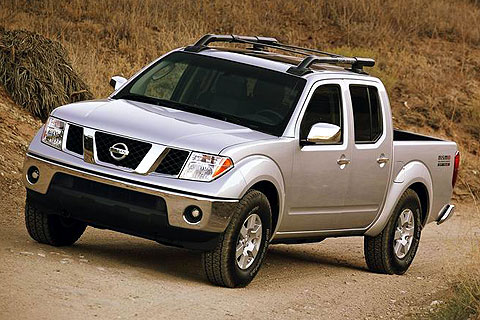 Nissan Frontier is the name for the D22 and D40 generations of Nissan pickup trucks in North, Central and South America and the Philippines. The line was started in 1998, and its immediate predecessor is the D21 Nissan Hardbody truck. As of 2002, the D22 series Nissan Truck is no longer sold in Japan, with the primary market having been relocated to North America, built at the Smyrna, Tennessee Nissan factory. Nissan was the pioneer of the Hardbody or Nissan Navara since 1986. The first was the D21, considered to be a small pick up. After more than 10 years with the D21, the second generation Navara was manufactured from 1998 and went until 2005 which was classed as a compact sized pick up. It was replaced with the bigger, taller, longer D40, which Nissan now considers to be a mid-size pick up truck. The Navara gets its name from the Navarre region of northern Spain, and the European version is built at the Nissan factory in Barcelona. The Frontier was introduced in 1997 for the 1998 model year as a replacement for the aging 1986.5–1997 Nissan Hardbody Truck. Nissan first offered the Frontier with a 4-cylinder engine, the KA24DE, but added the V6 engine, the VG33E in 1999. Elsewhere, the Frontier was also known as the Nissan Navara. That changed, with the introduction of the 2000 Frontier Crew Cab. The Crew Cab was the first compact pickup to offer a 4-door body-style in North America. Until that point, crew cabs were heavy duty versions of full-size trucks and were mainly used as commercial vehicles, although four-door compact pickups existed in Asia and Europe for decades. For 2001, Nissan facelifted the Frontier, introducing bolder styling in an effort to make it more appealing to younger buyers in its second generation. The Frontier was completely redone after the 2004 model year, which later resulted in the suspension of the regular cab model, indefinitely.


 Nissan has released the complete details and images of the 2010 Nissan Navara facelift along with the 2011 Nissan Pathfinder facelift. The 2010 Nissan Navara facelift are now powered by a new 3.0-litre V6 turbo V9X Engine diesel engine producing 240 hp (175 kW),406 lb-ft (500 Nm) @ 2,500 rpm and a revised 2.5-litre dCi unit(YD25DDTi High Power). The 2011 Nissan Navara and Pathfinder facelift V6 develop 170 kW (231 PS) and 550 Nm of torque between 1,700 rpm and 2,500 rpm an the famous YD engine which produces 190 PS (140 kW) and 450 Nm of torque an the VQ40DE remains the same with the 265 hp @5600 rpm; 291 ft·lbf (395 N·m) @4000 rpm. There are subtle changes to the headlights and the bonnet. The v-shaped grille shell is less pronounced and the bumper is rounder and projects 80mm further forward, but it's the six-spoke 17-inch alloy wheels or optional 18-inch alloy wheels that will be the plainest tell-tale to the new vehicle's identity. Inside the new Navara (top of the line model), Nissan designers have specified softer materials of a better quality for the dash, seats and interior moulds. The centre console and fascia designs have been revised, as have the instrument binnacle layout and door trims. Additional bright/gloss finish surfacing is used throughout the cabin. The six-stack CD audio system or the TV Navigation entertainment console is upgraded with speed-sensing volume, MP3 compatibility and Bluetooth connectivity for the (six-stack CD audio system). Other new or revised features include dual-zone climate control, remote audio/Bluetooth/trip computer controls on the steering wheel, trip computer, external temperature gauge, speed-sensitive variable windscreen wipers and 'follow me home' lighting. The electric mirrors now fold in fully for car washes or parking in narrow spaces. The Frontier is known as Nissan Navara in most of Europe and Australia and New Zealand, and Nissan Terrano in Chile (only D40 series is known as Navara). It is currently built in Smyrna, Tennessee, Spain, South Africa, Thailand, Philippines, China, Mexico, Brazil and Egypt.The D40 Navara has undergone Euro NCAP crash testing along with the Mitsubishi Triton and Isuzu D-Max, and received one star with a strikeout; however, after retesting with upgraded computer software it went from the lowest in the group to the highest (overall) with 3 stars. Among the problems discovered during the test was delayed airbag deployment and insufficient seatbelt restraint, which were solved with the software upgrade.